11th Jyothirlinga Triambakeshwar🕉️
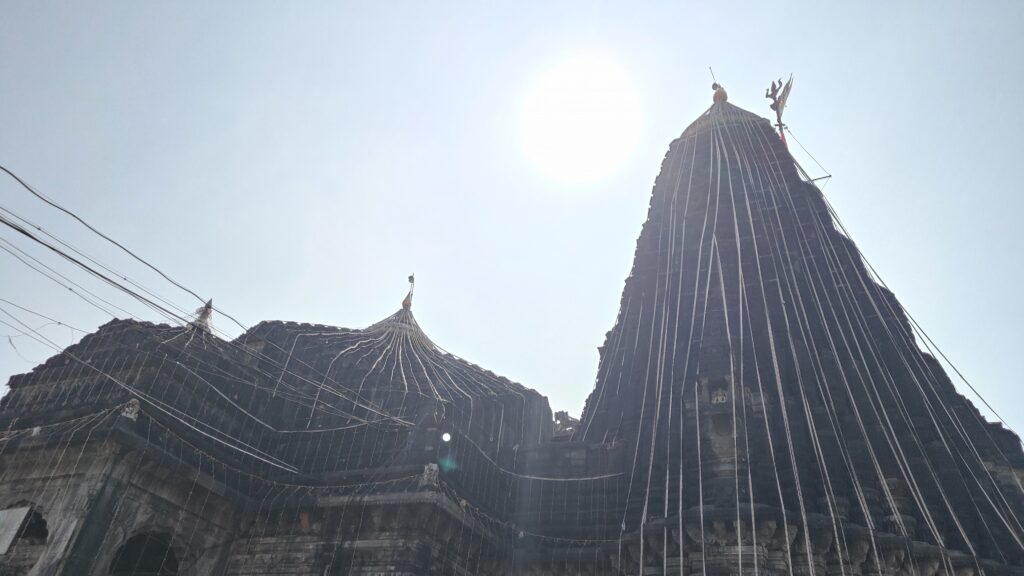
You know how some places make you feel like you’ve walked into something much larger than yourself? Not in a scary way — in a humbling way. The kind where you instinctively slow your pace, lower your voice, and feel something quietly rearrange itself inside you?
That is Trimbakeshwar. 🙏
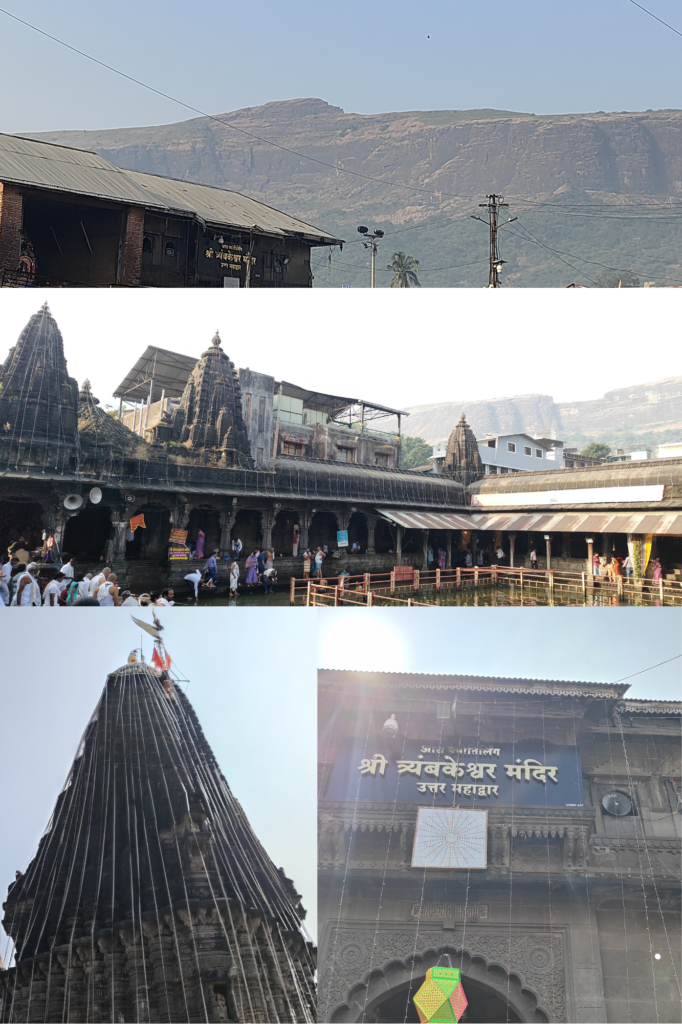
We drove from Nashik — just 28 km, barely 45 minutes, and honestly one of the smoothest legs of our entire Jyotirlinga journey 😄 — and yet from the moment we entered Trimbak town and caught sight of the temple’s black stone shikhara rising against the Brahmagiri hills, something shifted. The air here is different. Cooler. Quieter. Like the hills themselves are holding their breath.
Unlike any other Jyotirlinga we had visited. Not louder or grander — deeper. 🖤
🔱 The 11th Jyotirlinga — And Why It Is Completely One of a Kind
Let me tell you something that genuinely stopped me in my tracks when I first read it. Among all twelve Jyotirlingas, Trimbakeshwar is the only one that does not honour Lord Shiva alone.
The Jyotirlinga here has three faces — representing Lord Brahma the Creator, Lord Vishnu the Preserver, and Lord Shiva the Destroyer. The entire Hindu Trinity, the Trimurti, contained within a single Shivalinga. 😮
That’s why the name is Trimbakeshwar — Tri meaning three, Ambak meaning eyes or lords, Eshwar meaning God. Three Lords. One sacred space. One Jyotirlinga that is, in the most complete sense, the entire universe of the divine in a single form.
No other Jyotirlinga in India does this. Not one. 🕉️
And as if that weren’t extraordinary enough — this is also the origin point of the Godavari river, the longest river in peninsular India, the Ganga of the South. A Jyotirlinga AND a river’s birthplace. Trimbakeshwar really does carry the weight of the entire cosmos on its black basalt walls.
🏛️ The Temple — Black Stone, Ancient Energy and That Three-Faced Linga
The first thing you notice about Trimbakeshwar is the colour. While most temple complexes have some warmth to them — ochre or red or cream — Trimbakeshwar is built entirely of black basalt quarried from the Brahmagiri hills themselves. Dark, imposing, magnificent. The Nagara-style shikhara rises dramatically against the sky, covered in intricate carvings of deities, saints and mythological scenes that reward slow, careful looking. 😍
The current structure was built by Peshwa Balaji Baji Rao (Nana Saheb) in the 18th century — a marvel of Maratha craftsmanship. There is also a tiny, lovely story about how this temple came to be built: the Peshwa made a bet on whether the stone surrounding the Jyotirlinga was hollow inside or not. He lost the bet. And as his forfeit — he built the entire magnificent temple. 😄 Possibly the most wholesome thing a lost bet has ever produced.
Inside, the atmosphere is electric with devotion — bells, incense, chanting, the cool touch of ancient stone floors underfoot. And then you reach the sanctum. The Jyotirlinga here is unlike anything else on the entire circuit — it is not a protruding linga but a depression in the floor, and within it, three tiny thumb-sized faces of Brahma, Vishnu and Shiva emerge. They are covered during regular darshan by a jewelled crown said to date back to the era of the Pandavas. 👑
When I saw that three-faced linga — or rather, the glimpse of it — I genuinely had no words. It is small. It is worn. It is partially eroding from centuries of abhishek water (the temple trust has now built a protective covering). And it is the most quietly powerful thing I have seen on this entire Jyotirlinga journey.
Brahma, Vishnu, Shiva. Creation, Preservation, Destruction. The entire cycle of existence, in a palm-sized linga, in a black stone temple, at the foot of a hill where a river was born. 🥹
The Darshan — Blink and You’re Out
Okay let me be completely honest here because that’s what this blog is for. 😄
Trimbakeshwar has queues. The priests keep things moving. And when I say moving — I mean moving. You will not linger. You will not have extended personal time. You will get your glimpse of the three-faced Jyotirlinga, you will fold your hands, you will feel something enormous in approximately thirty seconds, and then the flow of the queue will carry you gently but firmly onward. 😅
This is not a complaint — millions of devotees visit and the system has to work. But if you are doing the Jyotirlinga circuit and have experienced the unhurried darshan of somewhere like Nageshwar, prepare yourself for a different pace here.
My advice? Do all your mental and spiritual preparation before you enter the sanctum. Know the legend. Know what you’re standing in front of. Know that in those thirty seconds you are in the presence of Brahma, Vishnu and Shiva simultaneously — a combination that exists nowhere else on earth. Let that sink in before the queue moves you forward, so that when your moment comes, your heart is already open and ready. 🙏
🌊 Kushavarta Kund
If the three-faced Jyotirlinga is the spiritual heart of Trimbakeshwar, then Kushavarta Kund is its soul. And we are SO glad we went. 🌊
Just outside the temple complex lies this sacred rectangular tank — the point where Shiva struck his trident into the earth and the Godavari first emerged. This is the literal birthplace of one of India’s greatest rivers. The water here is considered as holy as the Ganga herself, and most pilgrims take a dip (or at least pour the water on themselves) before entering the temple — a purification that feels entirely right for a place of this magnitude.
Standing at Kushavarta Kund, watching the Brahmagiri hills reflected in the still water, knowing that this is where the Godavari begins her 1,465 km journey to the Bay of Bengal — it was one of the quietest, most profound moments of our entire trip. 🥹
No rush here. No queue. Just you, the water, the hills, and the origin of a river. Sit for a while. You’ll be glad you did.
Final Thoughts 💫
Trimbakeshwar doesn’t just give you darshan of three gods. It gives you a front row seat to the most ancient, unbreakable covenant between devotion and the divine. 🥹
Come with your full heart. The three gods are waiting. 🧡
Jai Trimbakeshwar! 🕉️
Travel Tips ✈️🚂
Travel Mode 🧳
Flight 🛫
Nashik Ozar Airport (ISK) 50–55 km , Shirdi International Airport (SAG) 115 km taxis are available from both places.
Train 🚂
Nashik Road railway station is well connected to Mumbai, Pune, Delhi and beyond. From Nashik Road, it’s about 30–40 minutes to Trimbakeshwar by taxi.
Bus 🚌
Taxis, autos and shared cabs run regularly. If you’re staying in Nashik (which you absolutely should — more on that below), this is a simple morning excursion.
Accomodation 🏨
We stayed in Nashik and combined Trimbakeshwar with the Nashik sights — and this is genuinely the best way to do it. Nashik has a wide range of hotels across all budgets, excellent food, and enough sights (Panchavati, Sita Gumpha, the Godavari ghats, the wine trail if that’s your thing 🍷😄) to keep you happily busy for 2 nights.
Trimbak town itself has some basic guesthouses and dharamshalas for pilgrims who want to stay close to the temple — useful if you want to catch the early morning aarti at 5:30 AM without commuting. MTDC also has a property here.
But for comfort and variety? Stay in Nashik, day trip to Trimbakeshwar. Simple. Sorted. 😊
Food stops 🍽️
Around the temple you’ll find small local snack stalls — poha, upma, vada pav, chai. Nothing fancy but exactly right for a quick bite between darshan and Kushavarta Kund. 😄
For a proper meal — head back to Nashik! The city has everything from Maharashtrian thali places to North Indian, South Indian and more. And if you somehow find yourself in Nashik without eating misal pav — please correct that immediately. Nashik-style misal is its own spiritual experience. 🔥
Shopping zone 🛍️💳
The lanes around Trimbakeshwar have the usual pilgrim shopping options — and we browsed happily even if we didn’t go overboard 😄:
Pooja items — rudraksha malas, Shiva idols, bilva patra, incense, diyas,Kumkum and haldi — particularly vibrant and fragrant from the temple vendors,Religious souvenirs — framed temple photos, keychains, small deity figurines,Rudraksha beads — Trimbakeshwar is a particularly auspicious place to buy and energise rudraksha, given the Jyotirlinga’s power
Prices are reasonable, bargaining is welcome at smaller stalls. Don’t expect a big market — this is a small temple town, and the shopping reflects that. For more variety, Nashik city has you covered. 😊