12th Jyothirlinga Grishneshwar 🕉️
There is something about the number twelve that carries enormous weight when you’re a pilgrim on the Jyotirlinga circuit.
One by one, you collect them — each darshan a different energy, a different landscape, a different story. Somnath by the Arabian Sea. Nageshwar near the ancient city of Dwarka. Bhimashankar deep in the Sahyadri forest. Trimbakeshwar at the foot of Brahmagiri where a river was born. And then, after all of that — all the drives, the queues, the early mornings, the ghats, the chants, the tears, the laughs — you arrive at Grishneshwar.
The twelfth. The last. The final Jyotirlinga. 🥹
We came from Aurangabad — a short 30 km drive through flat Marathwada landscape, passing little villages and dry golden fields, until suddenly a red-stone shikhara appeared on the horizon and something inside my chest just — collapsed. In the best way. The kind of collapse that happens when something you’ve been holding very tightly finally gets to put it down.
I’m not going to pretend I didn’t cry. I did. 😭🙏
🏛️ The Temple — Red Stone, Rani Ahilyabai and Morning Calm
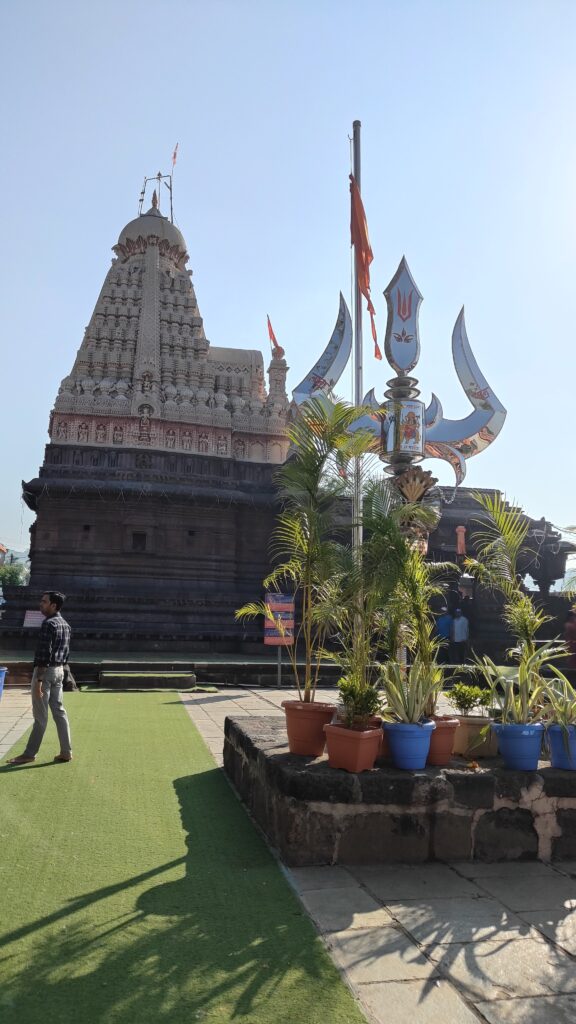
Step back and look at Grishneshwar from the outside first. Just take a moment. 😍
Built entirely of warm red volcanic basalt stone, with a five-tiered shikhara intricately carved with scenes from Shiva Purana and the ten avatars of Vishnu, the temple glows in the morning light in a way that genuinely looks like it was designed by someone who understood beauty deeply. It is compact, detailed, radiant. The smallest Jyotirlinga temple — and possibly the most exquisitely carved.
The current structure was rebuilt in the 18th century by the magnificent Rani Ahilyabai Holkar of Indore — the same queen who restored the Kashi Vishwanath temple, Somnath, and several other sacred sites across India. A woman who rebuilt India’s temples almost single-handedly. The sacred tank inside the complex is now named after her — Punyashlok Ahilyabai Holkar Shivalaya Tirth Kund. The least we can do is remember her name every time we visit. 🙏
We arrived early morning — and this is where I have to stop and just tell you straight: early morning at Grishneshwar is an entirely different world. 🌅
No rush. No crowd pressing behind you. The temple bathed in soft golden light, the red stone warming slowly, incense floating through still air. We had darshan. And then we had it again. And then once more — because no one asked us to hurry and Mahadev seemed in no rush to show us the door either. 😄🙏
Three darshans. The 12th Jyotirlinga. Multiple times. Unhurried. If you’ve been on this circuit you will understand exactly why I’m still emotional writing this. 🥹
🏛️ And Then — Ellora Caves, 1 km Away 🤯
Okay now let me tell you about the day we had. 😄
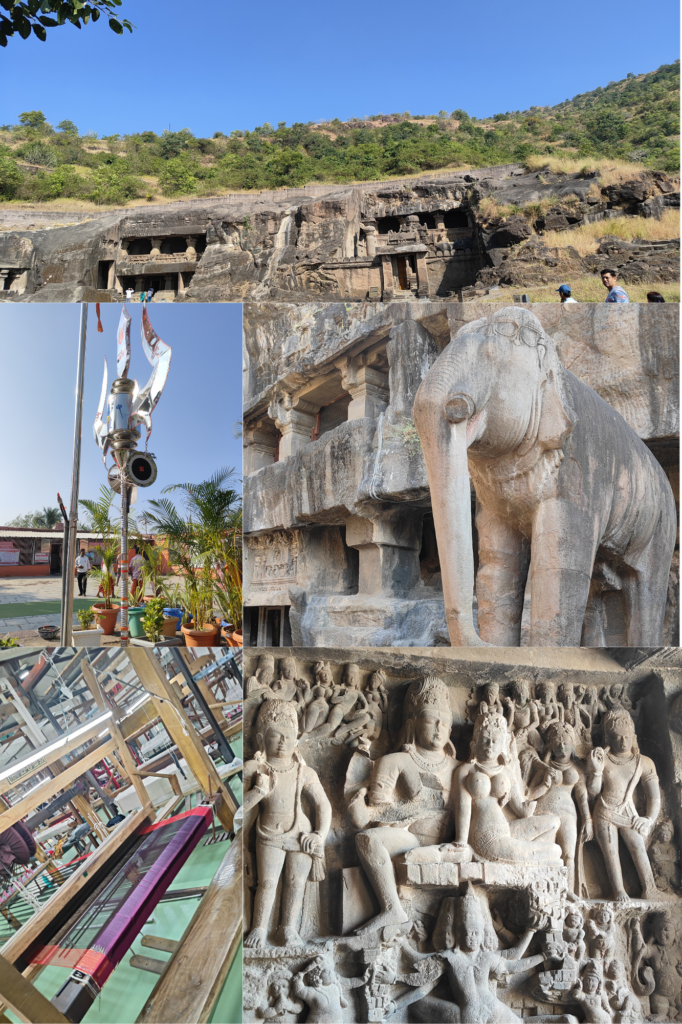
Darshan at Grishneshwar — emotionally complete, spiritually replenished, slightly tear-streaked — and then we walked approximately 1 km down the road and entered the Ellora Caves. One of the most extraordinary UNESCO World Heritage Sites on the planet. 34 rock-cut temples carved directly into basalt cliffs between the 6th and 11th centuries — Hindu, Buddhist and Jain monuments all existing side by side in complete harmony.
And the absolute star of Ellora — the Kailasa Temple (Cave 16) — a temple carved not built. The entire structure, top to bottom, was excavated downward from a single rock face. No bricks. No mortar. Just humans with chisels, working downward, removing rock to reveal a temple inside. It took an estimated 150 years and removed approximately 200,000 tonnes of rock. It is dedicated to Lord Shiva as Mount Kailash. 🏔️
So on the same day — same morning — we completed the 12th Jyotirlinga and stood inside the world’s largest rock-cut temple dedicated to the same Lord. 🤯
We didn’t plan it to be this poetic. It just turned out that way. Mahadev’s itinerary, not ours. 😄🙏
🙏 A Note at the End of the Circuit
I’ve been thinking about how to write this closing section for a while now. Because how do you sum up something that changed you?
Twelve Jyotirlingas. Twelve stories. Twelve different forms of the same divine light. A moon god’s curse. A sage’s penance. A devotee imprisoned in a dungeon who kept chanting. A woman who forgave the person who wronged her most. A river born from a god’s grace. Temples destroyed and rebuilt, again and again, by the hands of faithful people who refused to let the light go out.
Standing at the 12th Jyotirlinga, hands on the sacred stone, completing a circuit that had taken us across so much of this country — that is what I thought about. Not the distance we had covered. Not the temples we had ticked off a list. But the stories. The devotion. The human beings across thousands of years who kept coming back to these twelve points of light, again and again, because they believed that Shiva was there.
He is. He absolutely is. 🕉️
Come to Grishneshwar. Come at dawn. Touch the Linga. And if you’ve done all twelve — let yourself cry. You’ve earned every single tear. 🥹🙏
Jai Grishneshwar! Om Namah Shivaya! 🕉️
Travel Tips ✈️🚂
Travel Mode 🧳
Flight 🛫
Aurangabad Airport (Chikkalthana) is about 35 km from the temple, with flights connecting from Mumbai, Delhi and Hyderabad.
Train 🚂
Aurangabad Railway Station (~30 km) has good connectivity across Maharashtra and to major cities.
Bus 🚌
From Aurangabad (~30 km)— The most convenient base by far. Taxis, autos and state buses all run regularly to Ellora/Grishneshwar. It’s a comfortable 45-minute ride. We based ourselves in Aurangabad and it was absolutely the right call.
From Pune (~240 km) — About 4–5 hours by road. Doable as part of a longer Maharashtra Jyotirlinga road trip.
Accomodation 🏨
Aurangabad is your base — and a wonderful one at that. 😊 The city has hotels across every budget, excellent transport connections and enough sights to fill 2–3 days comfortably. We stayed here and it worked perfectly — early morning drive to Grishneshwar, darshan, then Ellora, back to the hotel by afternoon with the rest of the day to recover and process everything. 😄
MTDC has a resort near Ellora itself if you want to be closer — useful for a very early 4 AM aarti start without a long drive in the dark.
Food stops 🍽️
Around the temple — simple and honest, exactly as it should be for a place like this. 😊 Small local stalls, poha, upma, vada, chai. The kind of food that asks nothing of you except that you eat it gratefully while still in the glow of darshan. We kept it simple here and it felt right.
For a proper meal — head back to Aurangabad. The city’s food scene is genuinely excellent — Maharashtrian thalis bhakri roti aamras, and everything in between.
Shopping zone 🛍️💳
Okay so the shopping story here is not really about the temple market — it is about the road from Aurangabad to Grishneshwar, which is lined with some of the most beautiful textile and handicraft shops you will find anywhere in Maharashtra. And we went a little delightfully overboard. 😄
Paithani sarees — the queen of Maharashtra’s weaving tradition. Pure silk, intricate zari borders, peacock motifs, every colour imaginable. If you’re visiting Aurangabad and you don’t at least look at a Paithani, are you even there? We got one and the answer is yes, absolutely no regrets. 🦚
Himroo fabric — a traditional Aurangabad weaving art form that uses silk and cotton together, with stunning geometric patterns. Available as sarees, stoles, dupattas and — our personal favourite purchase — bed covers and table runners. We came back with armloads of these and every single person who has seen them at home has asked where they’re from. They’re gorgeous. 😍
The shops along this road are well-stocked, the weavers are often on-site, and the prices are very reasonable compared to what you’d pay anywhere else. Go early on the way to the temple so you’re not rushing through on the way back. And maybe bring an extra bag. Just in case. We learned this lesson slightly too late. 😅